Glucose Oxidase vs Other Oxidative Enzyme Tools
Oxidative enzymes are not interchangeable. They differ in what they consume, what they generate, how they affect color and flavor, and how easily they fit into a production line.
Glucose Oxidase is selected when a process needs controlled glucose conversion, oxygen reduction, and in-situ hydrogen peroxide formation. That makes it useful in oxygen management, dough systems, preservation concepts, biosensing formats, and controlled redox design.
This guide compares glucose oxidase with other oxidative enzyme tools so procurement, formulation, and process teams can choose the right functional route before requesting samples, pricing, or technical review.
The short answer
Use glucose oxidase when the value is tied to one or more of these outcomes:
- Reducing dissolved or headspace oxygen in a compatible matrix
- Converting glucose into gluconic acid derivatives
- Generating low, localized peroxide in the presence of oxygen and glucose
- Supporting mild preservation strategies where oxygen removal and redox shift are relevant
- Creating a measurable reaction for biosensor or diagnostic-adjacent formats
- Strengthening certain dough systems through oxidative effects
Choose another oxidative enzyme when the primary target is pigment oxidation, phenolic crosslinking, lipid oxidation, peroxide breakdown, or peroxide-driven color chemistry.
What makes glucose oxidase different
Glucose oxidase has a specific commercial logic: it links glucose, oxygen, and controlled oxidation.
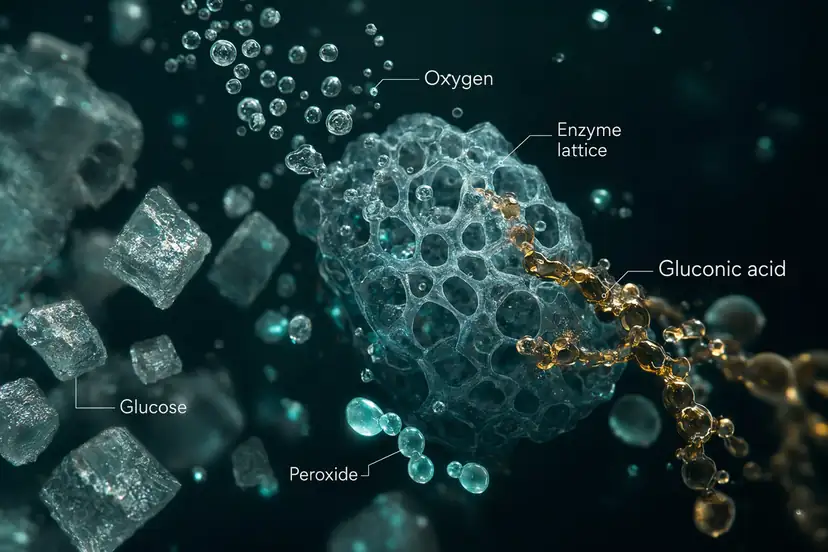
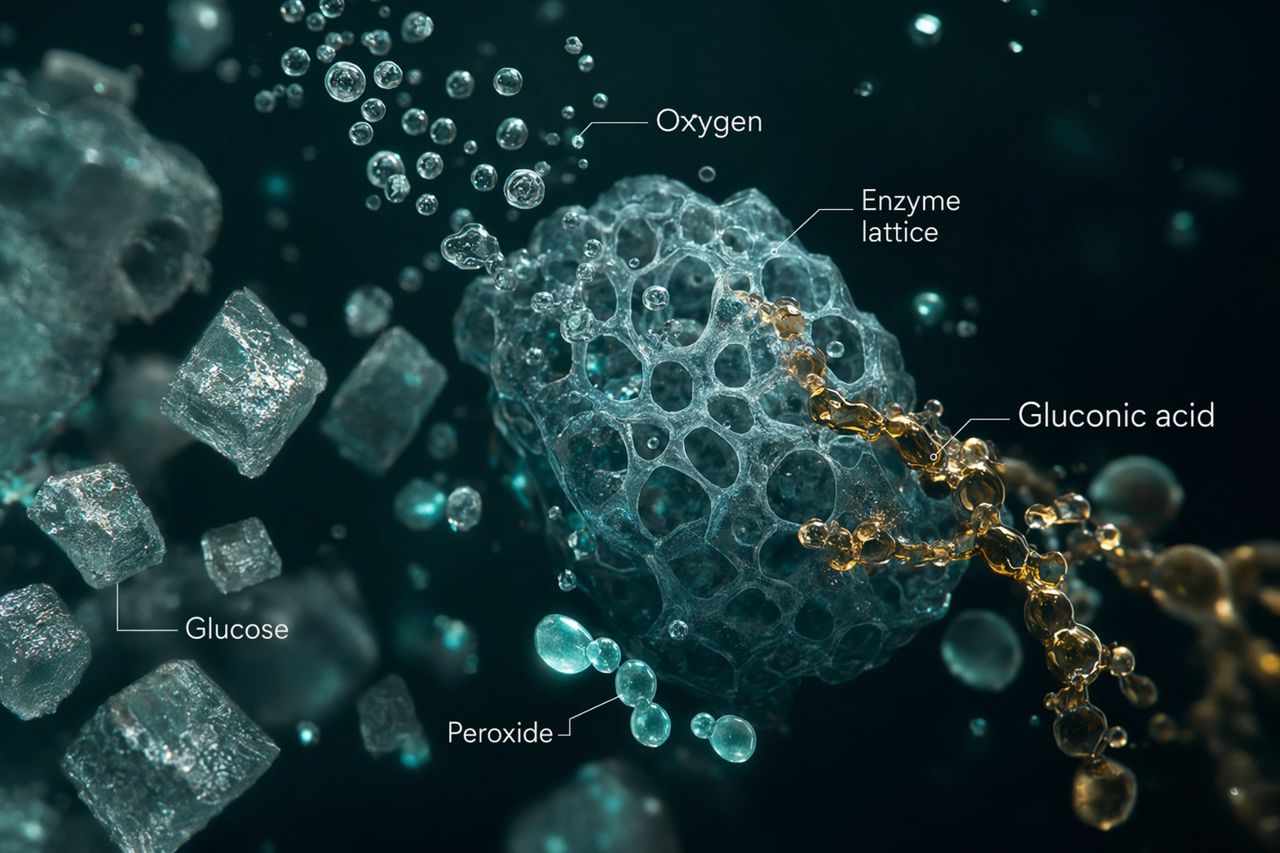
In simplified terms, the enzyme uses glucose and oxygen to form gluconic acid-related products and hydrogen peroxide. This gives formulation teams two functional levers at once:
- Oxygen is consumed from the system.
- Reactive peroxide is produced locally and can be managed by formulation design.
That combination is why glucose oxidase is often discussed as both an oxygen-scavenging enzyme and an oxidative processing tool.
The practical question is not whether glucose oxidase is more powerful than every alternative. The better question is: does the product need oxygen removal, glucose conversion, peroxide generation, or all three?
Comparison table: where glucose oxidase fits
| Enzyme tool |
Primary commercial function |
Key input or condition |
Typical decision point |
| Glucose Oxidase |
Oxygen reduction, glucose conversion, peroxide formation |
Glucose and oxygen availability |
Best when oxygen management is part of the value proposition |
| Catalase |
Peroxide breakdown |
Existing hydrogen peroxide |
Best when peroxide must be removed or controlled after formation |
| Peroxidase systems |
Peroxide-driven oxidation |
Hydrogen peroxide plus suitable donors |
Best when peroxide is already present or intentionally added |
| Laccase |
Oxidation of phenolics and related substrates |
Oxygen and compatible phenolic structures |
Best for color, polymerization, and phenolic modification routes |
| Lipoxygenase |
Oxidation of unsaturated lipids |
Lipid substrate and oxygen |
Best for lipid-linked bleaching, aroma, or dough-related oxidative effects |
| Hexose oxidase |
Broader carbohydrate oxidation |
Suitable sugars and oxygen |
Best when the substrate range is broader than glucose alone |
Glucose oxidase vs catalase
These two enzymes are often paired in technical discussions, but they perform opposite jobs.
Glucose oxidase produces hydrogen peroxide as part of glucose oxidation. Catalase breaks hydrogen peroxide down into water and oxygen.
Use glucose oxidase when peroxide formation is useful or when oxygen consumption is desired. Use catalase when residual peroxide is undesirable, process-sensitive, or needs to be reduced after an upstream oxidative step.
In some systems, the two can be designed together: glucose oxidase shifts oxygen and glucose chemistry, while catalase moderates the peroxide profile. That combination requires careful formulation review because catalase can reduce one of the intended oxidative effects of glucose oxidase.
Commercial takeaway
If your risk is oxygen exposure, glucose oxidase is usually the more relevant starting point. If your risk is peroxide carryover, catalase is the more direct tool.
Glucose oxidase vs peroxidase
Peroxidase enzymes use hydrogen peroxide to oxidize compatible donor molecules. They are useful when the process objective is a peroxide-driven reaction rather than oxygen depletion.
Glucose oxidase can generate peroxide in situ, but peroxidase systems typically need peroxide to be available and matched to a suitable donor chemistry. The two are sometimes considered together when a formulation needs a coupled redox sequence.
The critical difference is control logic:
- Glucose oxidase starts from glucose and oxygen.
- Peroxidase starts from peroxide and donor availability.
Commercial takeaway
Choose glucose oxidase when the formulation can supply glucose and oxygen and benefits from oxygen drawdown. Choose peroxidase when peroxide-mediated oxidation is the direct functional target.
Glucose oxidase vs laccase
Laccase is often selected for phenolic oxidation, color modification, polymerization, and crosslinking effects. It uses oxygen but does not operate around glucose conversion in the same way glucose oxidase does.
That makes laccase attractive in applications where the target chemistry is phenolic or aromatic in nature. Glucose oxidase is stronger when the target is oxygen scavenging, glucose transformation, or peroxide formation.
In food, beverage, textile, and biomaterial contexts, the distinction matters because laccase can strongly influence color and phenolic structure. Glucose oxidase tends to be chosen for more controlled oxygen and redox management, provided glucose is present or can be introduced.
Commercial takeaway
If the substrate of interest is phenolic, evaluate laccase. If the process depends on glucose and oxygen conversion, evaluate glucose oxidase.
Glucose oxidase vs lipoxygenase
Lipoxygenase acts on unsaturated fatty acids and lipid structures. It is used where lipid oxidation is the mechanism behind bleaching, dough effects, aroma development, or lipid-linked functional change.
Glucose oxidase does not require a lipid substrate. Its value comes from carbohydrate-linked oxidation and oxygen consumption. This can make it cleaner to position in formulas where lipid oxidation would create off-flavor, instability, or unwanted sensory change.
Commercial takeaway
If the desired reaction path runs through lipids, lipoxygenase may be relevant. If lipid oxidation is a risk, glucose oxidase may offer a more targeted oxygen-control route.
Glucose oxidase vs hexose oxidase
Hexose oxidase can act on a broader range of sugars than glucose oxidase, depending on the formulation context. That broader substrate range can be useful, but it may also reduce selectivity.
Glucose oxidase is typically favored when the process target is specifically glucose and when predictable glucose-linked oxygen consumption is valuable. Hexose oxidase may be worth evaluating when multiple sugars contribute to the desired oxidative profile.
Commercial takeaway
Use glucose oxidase for tighter glucose-specific design. Consider broader sugar oxidation tools when the available carbohydrate profile is mixed and the process benefits from that breadth.
Application-specific selection notes
Baking and flour systems
Glucose oxidase is used in baking systems where controlled oxidation supports dough handling, structure, and processing tolerance. It can help create oxidative conditions without relying on direct chemical oxidants in the same way.
When comparing alternatives:
- Lipoxygenase may be considered for lipid-linked flour effects.
- Laccase may be relevant for phenolic or fiber-associated modification.
- Glucose oxidase is often selected when dough strengthening and controlled redox shift are the main objectives.
The right choice depends on flour quality, formula sugar profile, water phase, mixing intensity, and the desired handling window.
Preservation and oxygen management
Glucose oxidase is a strong candidate where oxygen reduction is a useful part of shelf-life strategy. It can be relevant in compatible foods, beverages, ingredients, packaging concepts, and oxygen-sensitive intermediates.
Catalase becomes important if peroxide control is needed. The design question is whether peroxide is useful, neutral, or problematic in the final application.
Biosensing and analytical formats
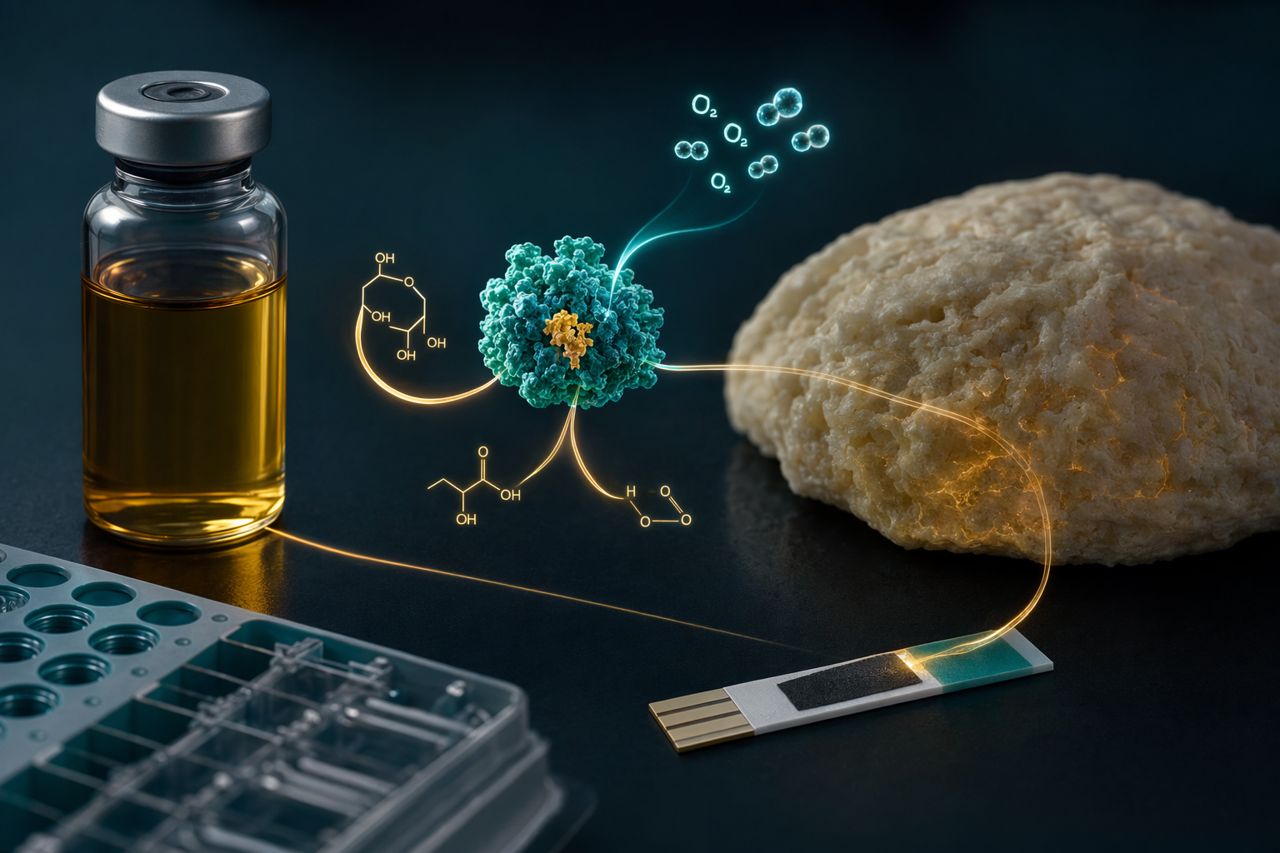
Glucose oxidase is widely recognized for glucose-linked signal generation. Its commercial relevance comes from the coupling of glucose conversion to a detectable redox event.
For biosensing concepts, the comparison is less about replacing other oxidative enzymes and more about whether glucose is the analyte or reaction trigger. If glucose is central, glucose oxidase is usually the natural starting point.
Beverage and liquid systems
In liquid systems, glucose oxidase may support oxygen reduction where glucose is present and the matrix is compatible. However, teams must assess pH, dissolved oxygen, temperature exposure, flavor sensitivity, and peroxide management.
This is where supplier dialogue matters: the enzyme may be technically suitable, but the complete system determines whether it is commercially practical.
Selection checklist for procurement and formulation teams
Before requesting pricing or samples, define the oxidative job in plain language:
- What must be consumed? Oxygen, glucose, peroxide, lipids, or phenolics?
- What can be tolerated? Peroxide formation, acidity shift, color movement, flavor risk, or viscosity change?
- What substrate is reliably present? Glucose, mixed sugars, phenolics, lipids, or peroxide donors?
- Where does the reaction occur? Dough, liquid, coating, film, dry blend, or sensor layer?
- When does the enzyme need to work? Mixing, holding, packaging, storage, or end use?
- What must remain stable? Flavor, color, protein structure, packaging compatibility, or downstream ingredients?
- How will success be measured commercially? Shelf-life extension, dough tolerance, oxygen reduction, signal response, cleaner label positioning, or reduced reject rate?
A clear answer to these questions prevents overbuying the wrong oxidative capability.
When glucose oxidase is the better first trial
Glucose oxidase is often the better first trial when:
- Glucose is naturally present or can be included without disrupting the formula
- Oxygen reduction is valuable to product quality or shelf life
- The formulation can manage peroxide formation safely and predictably
- A mild redox shift is preferred over aggressive oxidation
- The target system is aqueous enough for enzyme mobility
- The commercial goal includes process robustness, freshness, or measurable glucose response
It is not automatically the best choice when the desired reaction is pigment oxidation, lipid oxidation, or peroxide removal.
Specification topics to align before purchase
For B2B sourcing, the most useful specification conversation is not only about enzyme strength. It should cover:
- Physical form: liquid or powder
- Carrier and excipient compatibility
- Food, feed, industrial, or technical-grade positioning as applicable
- Allergen, GMO, and regulatory documentation needs
- Matrix pH and heat exposure during use
- Packaging size, lead time, and storage conditions
- Compatibility with sugars, salts, preservatives, oxidants, and reducing agents
- Documentation requirements for quality and import clearance
Oxyveil can help map the intended use case to the right glucose oxidase format before quotation.
Common buying mistakes
Mistake 1: Treating all oxidative enzymes as substitutes
An enzyme that uses oxygen is not necessarily an oxygen scavenger. An enzyme that creates oxidation is not necessarily suitable for glucose-linked systems.
Mistake 2: Ignoring peroxide management
Glucose oxidase can generate peroxide. Whether that is beneficial or problematic depends on the product. Build peroxide control into the concept early.
Mistake 3: Comparing only on price per kilogram
A lower price does not help if the enzyme targets the wrong substrate, destabilizes color or flavor, or requires reformulation.
Mistake 4: Starting without application context
The same enzyme can perform differently across dough, beverages, coatings, and sensor systems. Application context should guide sourcing.
Request a quote or get pricing
If you are comparing glucose oxidase with other oxidative enzyme options, send the intended application, product format, approximate annual demand, target market, and any formulation constraints. Oxyveil will respond with a fit-for-purpose recommendation and commercial quotation.
Bottom line
Glucose oxidase is not just another oxidative enzyme. It is a targeted tool for systems where glucose conversion, oxygen drawdown, and controlled peroxide formation create commercial value. Compare it by reaction role, not by enzyme category alone.